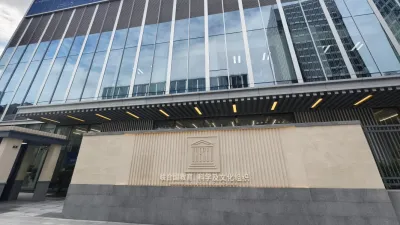
China has secured a new milestone in its growing role in global education governance after the formal launch of the UNESCO International Institute for STEM Education (IISTEM) in Shanghai.
The institute, officially inaugurated on May 14 during a high-level expert seminar and its inaugural governing board meeting, is the first Category I education institute established by United Nations Educational, Scientific and Cultural Organization in China.
Its opening also marks a broader institutional milestone: IISTEM becomes UNESCO’s 10th Category I institute worldwide, placing China more centrally within the organization’s global education architecture.
According to China’s state news agency, the institute’s launch follows several years of negotiations and approvals. China first submitted its proposal to establish a UNESCO Category I center focused on STEM education in 2022, and the proposal was subsequently approved by UNESCO’s General Conference. In 2025, the Chinese government and UNESCO formally signed the agreement establishing the institute, paving the way for operations to begin in 2026.
What is a UNESCO Category I institute?
Unlike UNESCO Category II centers, which are affiliated institutions supported by member states but legally separate from UNESCO, Category I institutes are integral parts of UNESCO itself.
This distinction matters.
Category I institutes are funded through intergovernmental arrangements, governed under UNESCO’s institutional framework, and directly aligned with the organization’s global strategic priorities.
In practical terms, hosting a Category I institute represents a higher level of institutional trust and international visibility than hosting a Category II center.
For China, the establishment of IISTEM signals not only growing domestic capacity in science and technology education, but also a stronger role in shaping global education agendas.
The launch comes at a time when STEM education has become increasingly central to international development policy, workforce planning, and national competitiveness strategies.
A global mandate with a developing-world focus
According to UNESCO, the new institute is mandated to promote inclusive, equitable, and quality STEM educationacross all stages of learning, from early childhood through adulthood.
The institute aims to become a global center for:
- STEM education research and innovation,
- international knowledge exchange,
- resource sharing,
- capacity development,
- and policy collaboration.
Its priorities reflect UNESCO’s broader development agenda.
Particular emphasis will be placed on:
- Africa,
- Least Developed Countries (LDCs),
- Small Island Developing States (SIDS),
- and initiatives supporting the participation of girls and women in STEM fields.
This positioning suggests the institute is intended not merely as a research center, but as a policy and capacity-building platform with global reach.
In an era when digital transformation, artificial intelligence, climate change, and technological disruption are reshaping labor markets and education systems, STEM has become a strategic priority for governments worldwide.
By anchoring a UNESCO institute dedicated to STEM education in Shanghai, China is strengthening its institutional presence in one of the most geopolitically significant areas of global education policy.
Why Shanghai?
Shanghai is a logical choice for the institute’s base.
The city has long positioned itself as one of China’s leading hubs for education reform, internationalization, scientific research, and technology innovation.
Its strong concentration of elite universities, research institutes, and education pilot programs provides an ecosystem aligned with the institute’s mission.
Hosting IISTEM also complements China’s broader ambition to expand its influence in international organizations and global standard-setting.
Over the past decade, China has sought greater participation in multilateral governance across education, science, public health, and digital regulation.
Securing UNESCO’s first Category I education institute in China can be read as part of this broader strategy.
Implications for global higher education
The establishment of IISTEM may also have longer-term implications for international higher education and STEM policy collaboration.
As governments worldwide seek to expand STEM talent pipelines, improve digital literacy, and address persistent inequalities in access to science and engineering education, the institute could emerge as an important node for research partnerships, policy experimentation, and South-South cooperation.
Its stated focus on underserved regions and gender equity also aligns with global concerns over uneven access to STEM opportunities.
For universities and education systems, the institute may create new channels for:
- collaborative research,
- curriculum development,
- teacher training,
- and international policy dialogue.
Its success, however, will likely depend on whether it can balance global inclusivity with China’s growing strategic interests in education diplomacy.
That tension will be closely watched.
Still, the launch of UNESCO’s International Institute for STEM Education marks a significant symbolic and institutional development.
For UNESCO, it expands the organization’s infrastructure for advancing STEM education globally.
For China, it represents a diplomatic and educational milestone: hosting, for the first time, a UNESCO Category I education institute embedded directly within the organization’s global institutional framework.
- Log in to post comments