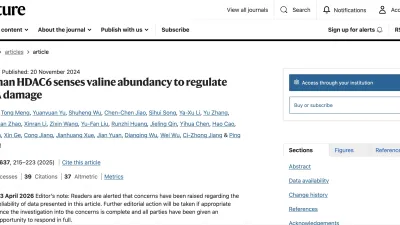
China’s Tongji University has removed a senior academic from his leadership role and terminated a researcher’s contract following an internal investigation that found academic misconduct in a paper published in Nature, reigniting discussion about research integrity and institutional accountability in Chinese higher education.
On May 6, Tongji University released the results of its investigation into concerns raised online about the paper Human HDAC6 senses valine abundance to regulate DNA damage, which was first published online in November 2024 and later formally published in January 2025.
The paper’s first author is Jiali Jin, a researcher affiliated with the Institute of Advanced Study at Tongji University. The corresponding author is Ping Wang, who had been serving as dean of Tongji’s School of Life Science and Technology.
According to the university, investigators reviewed experimental data and interviewed relevant personnel after online allegations questioned the reliability of multiple figures in the paper.
Tongji concluded that 14 figures contained problematic data or presentation issues.
Of these, 10 figures involved γH2AX immunofluorescence staining experiments. The university said researchers failed to objectively count both the total number of cells and the number of γH2AX-positive cells during data collection and processing, which it classified as academic misconduct.
Another figure involving mouse body weight data was criticized for non-standard documentation after one animal’s recorded body weight ended in the digit “0,” which the university described as an improper recording practice.
Three further figures involving immunoblotting and dot blot experiments were found to contain duplicated or misused images.
The university concluded that Ping Wang had failed to fulfill his responsibilities as corresponding author in ensuring the authenticity, reliability, and reproducibility of the research data and overall paper quality.
As disciplinary action, Tongji removed Ping Wang from his role as dean, downgraded his professional rank by two levels, and suspended his eligibility for salary advancement, promotion, research funding applications, awards, and related evaluations for 24 months.
Jiali Jin’s contract with the Institute of Advanced Study at Tongji University was terminated.
Tongji said the case would serve as a warning example and announced plans to strengthen research ethics education, reinforce integrity supervision, and conduct further monitoring and inspections of faculty and student research practices.
The decision was publicly praised by prominent Chinese biologist and academic commentator Rao Yi, who described Tongji’s handling of the case as a meaningful step for academic governance in China.
In a public commentary, Rao argued that universities willing to take disciplinary action in misconduct cases demonstrate stronger institutional standards than those that avoid or delay action. He said institutions that seriously address research misconduct are helping strengthen academic norms and improve the credibility of Chinese higher education and research.
Rao has long been one of China’s most outspoken public critics of academic misconduct and has repeatedly raised concerns about alleged research fraud over the years, sometimes expressing dissatisfaction with investigation outcomes or with institutions he believes have failed to adequately address misconduct allegations.
He framed the Tongji case as significant because it involved disciplinary action against a senior academic in connection with a high-profile international publication.
The case has also drawn renewed attention to a broader issue in Chinese academia. Multiple papers authored by well-known Chinese scholars are currently the subject of public allegations or online reporting related to suspected data irregularities, image duplication, or other research concerns. While public reporting does not itself establish misconduct, the visibility of these cases has intensified scrutiny of how universities and research institutions investigate allegations and communicate findings.
As China continues to expand its global research presence and invests heavily in scientific output, international publication, and university rankings, issues related to research integrity, reproducibility, and data management remain closely watched by both domestic and international observers.
The Tongji case is likely to remain a reference point in ongoing discussions about how Chinese universities balance institutional reputation, research performance, and accountability in cases involving alleged academic misconduct.
Whether additional institutions will face similar pressure as more allegations emerge remains an important question for China’s higher education and research sector.
- Log in to post comments