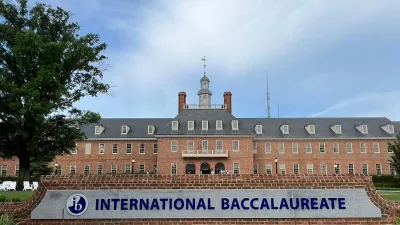
The International Baccalaureate has approved a major new strand within its flagship Diploma Programme (DP), marking one of the most significant curriculum reforms in the organization’s recent history.
Known as the Systems Transformation Pathway (STP), the new model is expected to be available to IB World Schools globally from 2030 following an expanded early adopter phase beginning in 2028. The pathway introduces a transdisciplinary, project-based approach centered on real-world global challenges including climate change, biodiversity loss, migration, food systems, and energy transition.
According to IB Director General Olli-Pekka Heinonen, the pathway aims to strengthen students’ ability not only to understand global problems but also to take meaningful action.
Speaking during the Education World Forum in London, Heinonen described the initiative as “a big step forward” that remains deeply connected to the IB’s founding mission of promoting peace, intercultural understanding, and social responsibility.
Shift away from purely subject-based learning
The STP represents a substantial departure from the traditional structure of the IB Diploma Programme.
Instead of focusing primarily on discrete academic subjects, students in the pathway will engage in systems-based learning that examines how complex global systems interact. Themes include food security, sustainability, migration, public wellbeing, biodiversity, and equitable economic development.
The pathway will still preserve core elements of the IB Diploma, including:
- Three Higher Level (HL) subjects
- One Standard Level (SL) subject
- Theory of Knowledge (TOK)
- Extended Essay (EE)
However, two standard-level courses will effectively be replaced by approximately 300 hours dedicated to the Systems Transformation course.
The new pathway emphasizes experiential learning, collaborative problem-solving, community engagement, and real-world project work rather than traditional classroom instruction and exam preparation.
Students participating in pilot programs have already undertaken projects related to refugee support systems, food waste reduction, biodiversity education, and public attitudes toward ecosystem restoration.
Alternative assessment model designed for the AI era
One of the most notable aspects of the STP is its assessment model.
Unlike traditional IB courses that rely heavily on final examinations, the Systems Transformation course will use a combination of:
- Project portfolios
- Case studies
- Reflective assessments
- Collaborative projects
- Community-based interventions
Assessment will be split evenly between internal and external evaluation, with 50 percent assessed by schools and moderated by the IB, and 50 percent assessed externally by IB examiners.
Heinonen suggested that this approach may also offer advantages in the era of generative artificial intelligence, arguing that collaborative and process-oriented assessments are more difficult to manipulate through AI-assisted cheating.
The assessment framework is intended to prioritize authentic learning experiences and iterative development rather than memorization-based testing.
Pilot schools already operating the pathway
The Systems Transformation Pathway has been piloted since 2023 at four IB schools across different regions:
- UWC Atlantic College
- United World College of South East Asia
- Upper Canada College
- Mulgrave School
At UWC Atlantic College, the pathway is known as “Leadership for Just Futures” and integrates systems thinking, human-centered design, leadership development, and project management.
More than 200 students across the pilot institutions have reportedly enrolled in the initiative so far.
Meanwhile, Upper Canada College has developed a bespoke course titled “Systems Transformation: Innovation for a Better World,” emphasizing design thinking, digital innovation, sustainability, and ethical problem-solving.
The Canadian school said the pathway may particularly appeal to students interested in entrepreneurship, engineering, medicine, social innovation, global politics, journalism, and the arts who seek more flexible and action-oriented learning experiences.
Universities and teacher training emerge as key priorities
As the IB prepares for wider adoption, university recognition and teacher readiness are emerging as central priorities.
Heinonen said the IB has already begun discussions with universities to ensure admissions officers understand the academic rigor and structure of the new qualification model.
At the same time, the organization acknowledges that teacher preparation may be the greatest implementation challenge. Because the pathway relies heavily on interdisciplinary teaching and facilitation rather than conventional subject-based instruction, the IB plans to spend the remainder of the decade training educators before the full rollout.
The organization hopes the gradual expansion process will avoid the implementation difficulties sometimes associated with rapid curriculum reforms.
Reflecting broader changes in global education
The Systems Transformation Pathway arrives amid growing international debate about whether traditional academic models adequately prepare students for rapidly evolving social, environmental, technological, and economic challenges.
The pathway also reflects wider shifts toward competency-based education, interdisciplinary learning, sustainability education, and authentic assessment models.
For the IB, the initiative could further differentiate the Diploma Programme in an increasingly competitive international education landscape, particularly among schools seeking more flexible and future-oriented curriculum models.
If successfully implemented, the STP may become one of the most consequential developments in international secondary education over the next decade.
- Log in to post comments