The Erasmus Mundus Association (EMA), the official global network representing students and alumni of the European Union’s Erasmus Mundus programme, descended into institutional conflict during its 2026 General Assembly after contradictory communications from the organization’s leadership triggered confusion over the legitimacy of the assembly and its voting procedures.
Founded with support from the European Commission, EMA connects thousands of Erasmus Mundus students and graduates worldwide and serves as a major stakeholder in the Erasmus+ international higher education ecosystem. The association operates as an independent international non-profit organization registered in Belgium and works closely with European institutions, universities, and Erasmus+ partner networks.
The crisis unfolded on May 28, just hours before the online General Assembly was scheduled to begin. EMA’s General Assembly Organising Committee circulated official agenda documents, voting descriptions, financial reports, and procedural information to members, stating that ten voting items would open simultaneously during the two-day session.
The voting documents included resolutions related to governance procedures, financial matters, and membership questions. Organizers stated that voting would remain open from May 28 to May 29 and would be limited to ordinary members in accordance with EMA statutes and internal regulations.
However, several hours later, EMA Vice President Shahin S. Eity publicly challenged the legitimacy of the voting process and accused the current presidency of bypassing recommendations from the European Commission and the Erasmus+ support structure. In an email sent to participants, the Vice President warned members not to rely on the previously circulated voting items and argued that several proposed resolutions contradicted recommendations issued by the European Education and Culture Executive Agency (EACEA).
The Vice President claimed that the “Erasmus+ Support Service team” had requested further internal consultation before finalizing the voting items. He also criticized what he described as unilateral decision-making by the current presidency and called for EMA to formally implement governance recommendations previously received from the European Commission and EACEA.
In his message to members, the Vice President referenced a petition signed by more than 120 EMA members requesting implementation of a governance reform timeline connected to recommendations reportedly issued by European authorities in December 2025. He proposed an alternative voting item asking members whether EMA should follow and implement the European Commission’s recommendations to resolve what he described as the organization’s “current governance crisis.”
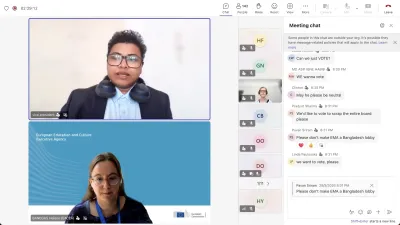
Despite the escalating dispute, the General Assembly proceeded online with approximately 140 participants initially attending the session. According to participants, EMA President Marvi Qazi did not attend the meeting, while EMA Vice President Shahin S. Eity participated directly in the discussions.
The session was also attended by Ms. Hélène Banegas, Policy Adviser for Erasmus+ International Alumni at EACEA. However, participants noted that the European Commission and EACEA do not possess direct legal authority to intervene in internal governance disputes within EMA, which remains an independent association under Belgian law.
Participants described intense procedural debates during the session, with members openly questioning whether the General Assembly remained legitimate after conflicting messages from EMA leadership. Concerns were raised regarding voting validity, procedural authority, quorum requirements, and the power of the President to unilaterally cancel the assembly after it had already begun.
During the ongoing General Assembly session, EMA President Marvi Qazi circulated a separate email formally announcing the cancellation of the General Assembly, stating that the decision had already been communicated to the European Commission and ICF, the Erasmus+ support service provider. The cancellation notice did not provide detailed legal or procedural justification for the decision.
The conflicting directives created confusion among participants during the live session itself. Attendance reportedly declined from approximately 140 participants to around 60 as discussions continued, reflecting growing uncertainty over the legitimacy of the proceedings and the authority of the organization’s competing leadership positions.
The dispute has also highlighted the unusual governance structure surrounding Erasmus+-related organizations. Although EMA is legally independent from European Union institutions, organizations linked to Erasmus+ frequently operate within a broader ecosystem of compliance expectations, operational oversight, and institutional coordination involving EACEA and external support contractors.
Participants noted that ICF, which formally acts as a service provider supporting Erasmus+ structures, also plays an important role in ensuring that Erasmus+-related organizations comply with governance and operational standards expected by the European Commission. This creates a complex relationship in which organizations such as EMA maintain legal autonomy while remaining heavily dependent on institutional recognition and operational cooperation within the Erasmus+ system.
Observers noted that the conflict appears to reflect deeper structural tensions within international student and alumni organizations connected to European higher education initiatives. Similar governance disputes have reportedly emerged in other Erasmus+-related networks, including the OCEANS Network, where disagreements during leadership handovers between outgoing and incoming boards have also raised questions over organizational continuity and authority.
The EMA dispute illustrates the growing governance pressures facing international volunteer-based student organizations as they evolve into globally connected institutions operating within increasingly formalized regulatory and compliance environments. Analysts note that many such organizations were originally built around informal volunteer cultures but now face growing expectations regarding transparency, constitutional procedures, financial accountability, and democratic governance.
As of publication, it remains unclear whether any resolutions discussed during the General Assembly will ultimately be recognized as valid under EMA statutes or Belgian association law. Further clarification from EMA leadership and institutional stakeholders is expected in the coming days.
- Log in to post comments