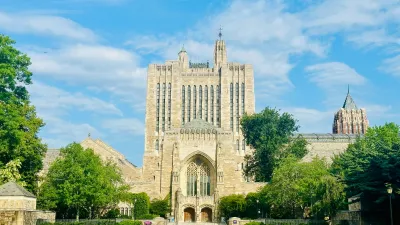
A new report from the Yale chapter of the American Association of University Professors (AAUP) suggests that a growing number of faculty members believe their academic freedom has deteriorated since January 2025, leading many to modify what they teach, research, and discuss publicly.
Based on a survey of 177 faculty members and researchers, the report argues that faculty are responding to a combination of political pressures, funding uncertainty, immigration concerns, and doubts about institutional protections. According to the authors, the result is a pattern of self-censorship that is narrowing what Yale faculty teach, research, and communicate to the wider public.
The report's central conclusion is that many faculty members are increasingly managing academic and professional risks on their own because they are uncertain whether university leadership will defend academic freedom when it is challenged.
Faculty report growing concern about professional consequences
The survey found substantial concern about potential repercussions arising from teaching, research, and public engagement. Nearly half of respondents reported significant concern about facing disciplinary action from Yale because of their public engagement. More than half worried about anonymous complaints, while many expressed concerns about reputational damage, public harassment, and employment consequences.
The report also found that approximately one-fifth of respondents had been asked by an administrator to change language related to a course, research project, website, or other academic activity. For the authors, such findings contribute to a broader perception among faculty that the boundaries of acceptable academic expression are becoming increasingly uncertain.
Concerns were particularly pronounced among faculty without tenure protections. The report notes that untenured faculty consistently reported higher levels of anxiety and were more likely to alter their teaching, research, and public engagement activities.
International scholars feel especially vulnerable
One of the most striking findings concerns non-citizen faculty members.
According to the survey, 70% of non-citizen respondents reported concern about the possibility of deportation connected to their academic work. Faculty members also expressed broader worries about immigration processes affecting international colleagues and students.
The report identifies these concerns as part of a wider challenge facing American universities. International scholars are central to research, innovation, and teaching, yet many now face uncertainty not only about immigration policy but also about whether institutions can adequately protect them during periods of political tension.
Self-censorship is reshaping academic life
The report argues that the most significant consequence of these concerns is behavioural change.
Approximately one-third of respondents reported avoiding potentially controversial topics in lectures, seminars, or classroom discussions. Similar numbers reported modifying teaching plans or course materials.
In research, one in five respondents said they had abandoned scholarship on topics they considered potentially controversial. Others reported altering how they describe research projects or academic work.
The effects extend beyond the classroom and laboratory. Nearly half of respondents reported stepping back from public engagement, including interactions with journalists, public commentary, social media participation, and signing public statements.
According to the report, these changes do not necessarily result from direct censorship. Rather, they reflect anticipatory self-censorship, with faculty adjusting their behaviour to reduce perceived professional, political, or personal risks.
A question of trust and governance
While the report acknowledges the increasingly politicized environment facing higher education, its analysis focuses heavily on Yale's internal policies and governance structures.
Faculty repeatedly expressed uncertainty about what protections they could expect if their teaching, research, or public engagement became the subject of complaints or political controversy. The report argues that Yale has not clearly defined the scope of academic freedom protections or established sufficiently transparent procedures for defending them.
As a result, many faculty members feel they must navigate these risks independently.
The AAUP argues that restoring confidence will require more than public statements supporting academic freedom. It calls on Yale to codify academic freedom protections in the Faculty Handbook, strengthen job security for non-tenured faculty, establish faculty-led mechanisms for addressing academic freedom disputes, and expand meaningful faculty participation in university governance.
Implications beyond Yale
Although focused on Yale, the report speaks to challenges confronting universities across the United States and internationally. The findings suggest that academic freedom can be constrained not only through direct restrictions but also through uncertainty, perceived risks, funding pressures, and a lack of confidence in institutional protections.
For higher education leaders worldwide, the report offers a reminder that academic freedom depends not only on formal rights but also on trust. When faculty are uncertain whether institutions will defend those rights, self-censorship can become a powerful force shaping what universities teach, research, and contribute to public debate.
- Log in to post comments