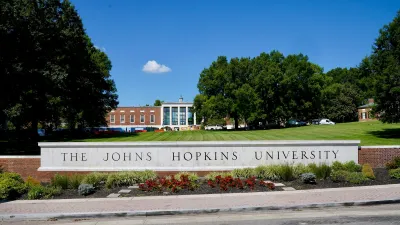
Johns Hopkins University has laid off approximately 110 employees following another sharp decline in federal research funding, highlighting the growing financial pressures confronting research-intensive universities across the United States.
The workforce reduction, which primarily affects administrative positions, comes after the university spent much of the past year implementing cost-saving measures designed to avoid compulsory redundancies. Despite those efforts, university leaders concluded that further restructuring had become necessary as federal research support continued to contract.
"As our federal research portfolio shrinks, the infrastructure around it must change in parallel," a university spokesperson said, describing the layoffs as part of a broader effort to align administrative operations with a significantly smaller research funding base.
The latest reductions follow an exceptionally difficult period for the institution. According to university president Ron Daniels, Johns Hopkins' federal research portfolio declined by more than US$500 million during 2025, representing a 43% drop in federal research funding and a 28% reduction in the number of research awards compared with the previous year. University leaders say the downward trend has continued throughout 2026.
In a message to the university community earlier this month, Daniels acknowledged growing concern among researchers over prolonged uncertainty surrounding federal grant decisions.
"Colleagues have expressed confusion, uncertainty, and frustration with the pace and character of decisions from federal granting agencies, especially in the natural and life sciences," he wrote. "Though our colleagues continue to submit strong research proposals, the sluggish or stalled pace of awards is debilitating."
The layoffs form part of a broader institutional restructuring strategy. Johns Hopkins plans to reduce administrative spending by 10%, streamline research support operations through greater use of technology, eliminate duplicated processes, and control rising employee benefit costs. The university is also seeking to diversify its revenue through expanded corporate research partnerships and new academic programmes.
To help sustain research activity during the funding downturn, the university has established a Research Resilience Fund that will distribute US$60 million annually over the next two years to support researchers whose projects have been affected by federal funding disruptions.
Despite the cuts, university leaders emphasise that Johns Hopkins remains financially strong. For fiscal year 2025, the institution reported an operating surplus of approximately US$492 million and a total surplus exceeding US$2.2 billion. However, administrators argue that long-term financial strength does not eliminate the need to adapt to a significantly altered research funding environment.
The latest announcement follows a much larger workforce reduction in 2025, when the university eliminated more than 2,200 positions in the United States and overseas after major reductions to programmes funded through the U.S. Agency for International Development (USAID). Throughout last year, Johns Hopkins also implemented a hiring freeze, eliminated vacant positions, slowed capital expenditure, and suspended salary increases for employees earning more than US$80,000 annually.
The university's experience reflects a broader trend across American higher education. Research universities have increasingly responded to uncertainty surrounding federal funding by slowing recruitment, postponing capital projects, restructuring administrative operations, and reducing staffing levels. While public attention has often focused on disputes over campus protests, diversity initiatives, climate programmes, and other policy issues, the most immediate operational consequence for many institutions has been growing instability in research funding.
For internationally recognised research universities such as Johns Hopkins, federal grants underpin not only scientific discovery but also thousands of research and administrative jobs. As funding becomes less predictable, universities are increasingly seeking alternative revenue sources while reassessing the scale of their research infrastructure.
Whether further workforce reductions become necessary will depend largely on the future direction of federal research funding. For now, Johns Hopkins joins a growing number of leading universities attempting to balance financial resilience with continued investment in research during one of the most uncertain funding environments in recent decades.
- Log in to post comments