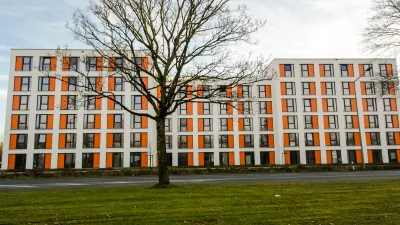
Germany has long been regarded as one of the world's most attractive destinations for international students. Tuition-free or low-cost public universities, internationally recognised qualifications, and a strong economy have attracted hundreds of thousands of students from around the globe. Yet a growing structural problem is beginning to undermine these advantages: the shortage of affordable student housing.
According to the 2025 Statistical Overview published by the Deutsches Studierendenwerk (DSW), Germany's publicly funded student accommodation system is struggling to keep pace with rising enrolments. The findings suggest that housing availability has become a critical challenge—not only for students but also for universities seeking to compete in an increasingly global higher education market.
Public housing supply fails to keep pace with enrolment growth
As of 1 January 2025, Germany had 241,732 publicly funded student housing places across 1,736 residential complexes. Although this represents an increase of approximately 19,300 beds since 2007, the expansion has been modest compared with the rapid growth in university enrolments.
Over the same period, Germany's student population increased by approximately 27%, while public accommodation capacity expanded by less than 9%. Consequently, the proportion of students able to secure public housing has steadily declined.
The national student accommodation rate has fallen from 11.86% in 2007 to 10.12% in 2025, meaning that nearly nine out of every ten students must now rely on Germany's increasingly competitive private rental market.
For many international students, this has significant financial consequences. Public student residences remain by far the most affordable housing option outside the family home, with an average monthly rent of €318.18, including utilities. Students unable to secure a place often face private rents that are two or even three times higher, substantially increasing the overall cost of studying in Germany.
Germany's student housing in numbers
- Total university students: 2,388,125
- Public student housing places: 241,732
- Average monthly public residence rent: €318.18 (including utilities)
- National accommodation rate: 10.12%
While Germany continues to attract growing numbers of domestic and international students, affordable accommodation has not expanded at the same pace.
A highly uneven regional picture
The national average masks considerable regional disparities. Student housing availability varies significantly across Germany's sixteen federal states, creating very different experiences depending on where students choose to study.
Several eastern states continue to provide comparatively good access to public accommodation. Thüringen offers public housing for 18.16% of students, followed by Brandenburg (15.98%) and Sachsen (15.79%). These regions generally benefit from legacy housing infrastructure and comparatively lower pressure on local property markets.
By contrast, Germany's largest metropolitan and economic centres face severe shortages.
| Federal State | Student Housing Coverage |
|---|---|
| Thüringen | 18.16% |
| Brandenburg | 15.98% |
| Sachsen | 15.79% |
| Baden-Württemberg | 14.71% |
| Bayern (Bavaria) | 9.38% |
| Nordrhein-Westfalen | 8.47% |
| Berlin | 5.09% |
Berlin illustrates the scale of the problem. Despite hosting more than 179,000 students, only around 5% can access publicly funded accommodation, leaving the overwhelming majority to compete in one of Europe's most expensive rental markets.
Similar pressures are evident in Bavaria and North Rhine-Westphalia, home to many of Germany's leading universities and strongest regional economies.
Construction alone will not solve the shortage
The DSW reports that approximately 19,657 additional student housing places are currently planned or under development nationwide. Of these, 9,157 beds are under construction, while 10,500 remain in advanced planning.
Bavaria leads current construction activity with nearly 4,000 beds under development, followed by North Rhine-Westphalia.
However, these investments are unlikely to resolve the shortage in the near future. Many existing student residences are simultaneously undergoing renovation and modernisation, temporarily removing hundreds of beds from the market. Cities including Frankfurt am Main, Erfurt, Marburg and Ilmenau have all experienced temporary capacity reductions due to refurbishment projects.
As a result, the net increase in available accommodation is expected to remain limited over the coming years.
Implications for international higher education
For universities, education agents and international recruitment professionals, student housing is no longer simply a welfare issue—it has become a strategic factor in international student mobility.
Institutions located in high-demand cities such as Berlin, Munich and Cologne increasingly need to help prospective students develop accommodation plans well before arrival. In many cases, students should begin searching for housing at least six months before the start of their studies.
Conversely, universities located in regions with stronger public housing provision may gain a competitive advantage. States such as Thüringen and Sachsen can offer international students not only lower living costs but also greater certainty during the transition to university life, making them attractive alternatives for budget-conscious applicants.
Looking ahead
Germany remains one of the world's leading destinations for higher education, and its universities continue to enjoy a strong international reputation. However, maintaining this position will require more than academic excellence.
Affordable housing has become an essential component of a successful internationalisation strategy. Without sustained investment in student accommodation, Germany risks seeing housing constraints undermine its ability to attract and retain global talent. As international competition for students continues to intensify, ensuring that students have somewhere affordable to live may prove just as important as the education they come to receive.
- Log in to post comments